

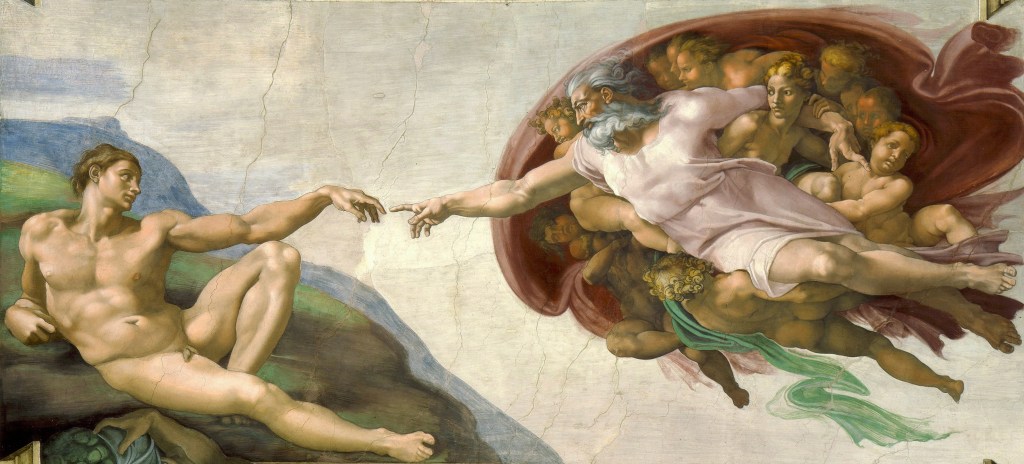
Imago dei or the Image of God is something so comfortable to think about from Sunday school days or trips to see the great European works of art through the centuries. With a degree in Art History looking at the history of God’s visual image through art is enjoyable, if not misleading.
If there is one message throughout my writings it will be this; women and moms are empowered with their own ability to resonate with God’s truth. Specifically that God loves you and created you to have a personal direct relationship with him. Trust your own ability to converse with God, to seek him in the Bible. You don’t have to adopt a commonly held perspective because it was created for you centuries ago or by others. Don’t get me wrong, loving your fellow Christ-followers and praying with them for discernment is wonderful and needed. Asking for advisement or guidance from the church is terrific and I do that very often while forming my own understanding. But Know and TRUST yourself! God can reveal himself directly to you; what he feels about disability in the world and with his children.
Just as we have started to challenge ourselves in the two previous posts with our own definition of disability, and what biblical lens we use … now we need to read, discern and pray through scripture to look at the Image of God. To start, what if I was to make you a bit uncomfortable? For a moment embrace the Harmonia Rosales’ painting below. The painter dared to reimagine the God from my childhood and all the European Master’s versions.
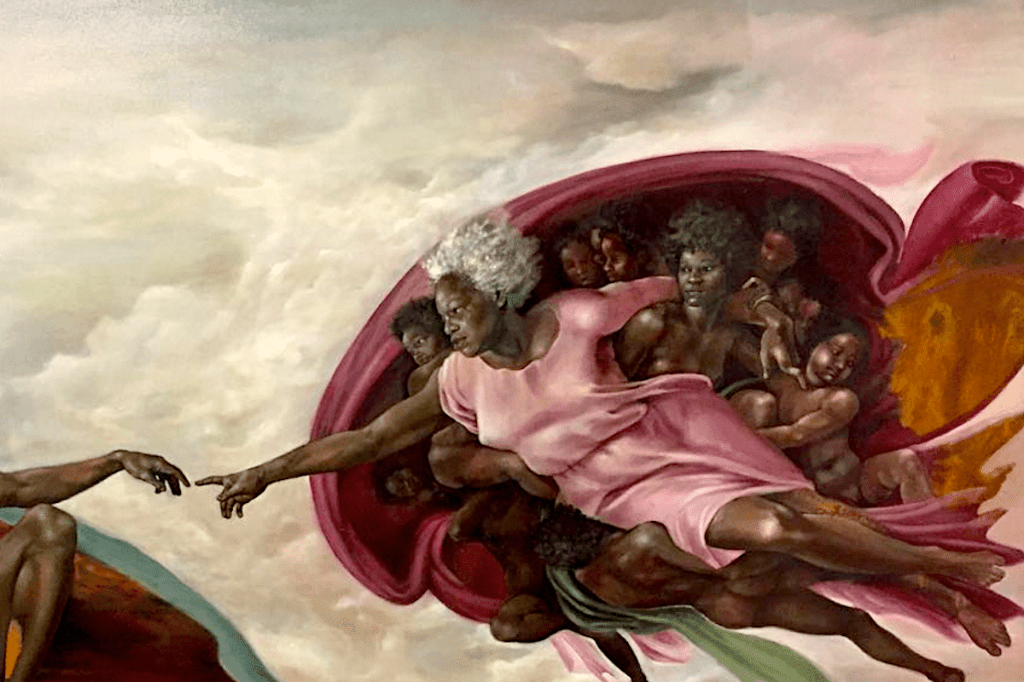
What was your instantaneous thought at the first view of this painting? Was it a smile, a degree of comfort for seeing yourself when God is a woman? Do you relate more because God looks more like a mother with her children than a Man with his cherubs? Was it because God is represented as a person of color? Was it jarring? Did a person’s name come to mind that would hate this painting, and is that your way of avoiding your own feelings? Or were you uncomfortable because that is just not the image Of God you had in mind? Which image makes you most comfortable, Michelangelo’s or Rosales’? Why? What if the image was reimagined with a human in a wheelchair or blind? What if in Michelangelo’s painting was a person with cerebral palsy or Jesus with his cruxifixction scars? What do you think God would say about these paintings and thoughts compared to God’s own self-image in the Bible? (Okay a Christian parent’s joke … I can’t stop hearing in my head the voice in the cartoon Veggie Tales; “questions, questions questions”.)
Now pause and think, when you think of God what is the first image you hold in your mind? Did that image originate with you or come from elsewhere? All your answers might be very new thoughts for you. I get it, I was blown away with all sorts of responses and imagery in my head. What did God say in the Bible about his own image? A topic so big, that we intentionally will only get to scratch the surface. I begin with a prayerful heart and specifically a mother’s and a disability perspective. My hope is that you actively read this and ask the questions so that you may be enlightened through the truth of scripture.
If you are into bible studies you might know that there are over 60 common English versions of the Bible. This is not different languages or historical text, but versions of the Bible. Just go to biblegateway.com and look up one verse in the different versions. What a gift from God to have different interpretations and versions of his sacred word for you. Personally I use the New International Version (NIV), but always like to search the others. Here we use five different versions of the same scripture to look at the first mention of God’s image. As you read them consider what is similar between them? What is different?
Genesis 1:27
So God created man in his own image, in the image of God he created them: male and female he created them. (NIV)
Then God said, “Let us make man in our image, after our likeness. (EVS)
So Elohim created humans in his image. In the image of Elohim he created them. He created them male and female. (NOG)
God spoke; “Let us make human beings in our image, make them reflecting our nature so they can be responsible for the fish in the sea, the birds in the air, the cattle, and yes Earth itself, And every animal that moves on the face of Earth.” God created human beings; he created them godlike, Reflecting God’s nature. He created them male and female. God blessed them … (MSG 1:26-28)
So God created man in his own image, in the image of God Created he him; male and female he created he them. (KJV)
What was the result for you? What is consistent and what is different? A difference: three of the versions say man in his image; male and female. The other two say created humans; male and female. The second two makes better sense to me personally as I have a few parts my husband does not have, he has one major part I don’t (one that makes camping and hiking easier). Pardon if I offend here, but if we were made in his physical image; male and female, would it not follow that God should be pictured as having all three parts? If we go with the physical this would lead down a slippery slope where we are once again forced to ask the questions; is God tall or short, light weight or heavy weight, bald or with curly hair, what race, country, skin color … is he able or visibly disabled? Finally note another difference in that two of versions have in his “likeness” or “reflecting our nature”.
You can see why I gravitate to Bible versions of the 60 that stress the “human”, “likeness” and “nature”. In my ordinary way I can wrap my imperfect mind around those versions because they take the whole-Bible-view context. The whole Bible talks about God’s nature and attributes. God is _____. Fill in the blank with your favorite nature, attributes and traits of God. I’ll start with___creator___. I am in his image because I share the attribute of creator as a parent. All mom’s share this attribute along with the Hebrew biblical Chavah (Ha-vah); humanity’s first mom, Eve, giving life, breathe, mother of the living. Yep, I’ll start with that one and add
Loving, Kind, Joy, Slow to Anger, Accessible, Father/Son/Holy Ghost, Faithful, Good, Gracious, Guide, Invisible, Immutable, Impartial, Incomprehensible, Invisible, Jealous, Just, Merciful, Omnipotent, Omnipresent, Patient, Perfect, Person, Preserver, Provider, Righteous, Savior, Redeemer, Sovereign, Wise …. Just to name a few from a Bible Study I have been going through this year ….
Colossians 3:10 And have put on the new self, which is being renewed in knowledge after the image of its creator. (NIV)
I would love to see your list of scripture verses on the character, nature and likeness of God. (Send in the comment section below!).
A mom, daughter, grandma, sister, who has a child or family member living disability every day – there is hope as we look to define the image of God. I don’t know about you, but in my child with a disability I see glimpses of the image of God in his likeness. Only God has those attributes to their infinite perfection being as a whole, without the ability to single out any one. But we all are human and thus can’t possibly be the perfect state of all or any of those attributes. We can’t be invisible or omnipotent, omnipresent, but we can be knowing, have invisible thoughts, and be present for our child. We can single out some to continually become just a fraction more in the likeness of God. I suggest your loved one, your child, is created in the nature and likeness of God with some, definitely not all the attributes of God. Definitely with the hope of becoming more in God’s likeness before we are finally joined with Him. It is a process of becoming more Christ-like, dare I say the “church” word sanctification. More in the next post on that. Right now my head is spinning and I am a bit giddy with hope as I begin to glimpse the reflection of the image of God’s in my child.
In closing and having just gotten started on imago dei, or the Image of God. A quote from a favorite theologian.
“If the Christian faith is distinctive precisely in its trinitarian understanding of God, then to be created in the image of God means to be created in the image of God as Father [parent], Son [God as human], and Holy Spirit.” – Dr. Amos Young 2007
Reflection: 2 Cor 4:4 the light of the gospel of the glory of Christ, who is the image of God. (NIV)
Assignment:
1 – If you don’t already know, find your version of the Bible. Ask others you worship or study with what version they use or prefer.
2 – Ask others to look at the two paintings and ask them the questions from today’s post (be careful not to influence them and without judgement). Just listen and learn from their responses.
3 – If you have a disability (like me), or have a precious child with one (like me), reflect on the attributes and nature of God known through scripture. (Don’t stop with my list). How do you or your loved one reflect any or part of those qualities or attributes? How do they bring those qualities out in others? How are we mom’s and caregivers becoming made more in the image of God?
Prayer. God, you are beautiful, joyful, loving, all knowing. Males and Females, all humans are made in your image. Thank you. Thank you that I am a mom, reflecting your likeness and sharing the qualities of Chavah; life giving, the first mom, now sisters with all moms. Help my eyes to see, my ears to listen, my heart to pulsate with truth of who you are. Enlighten me Father in your ways. Give me a renewed spirit in light of the gospel of Christ who is in your image. We pray for your empowerment, enlightenment and strength. Help me support my fellow moms and sisters in our common questions, needs and weariness. Finally Lord, use me/us to your glory, and if I can be bold let our days be filled with joy. Amen
Next post we continue by exploring imago trinitas, or the Image of the triune God (Father/Son/Holy Spirit) and Disability.
Additional References:
Theology and Down Syndrome, Reimaging Disability in Late Modernity. Amos Young 2007

 Chavah Mom